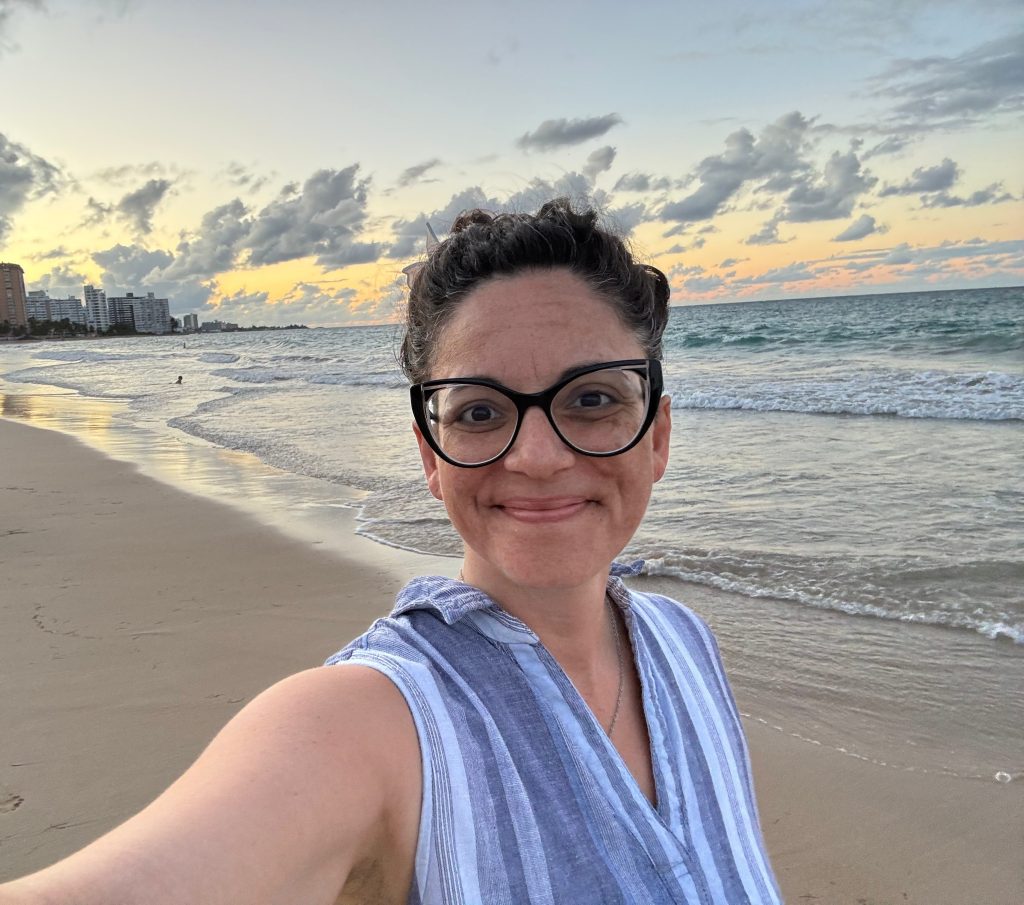
How are you?
I can not count how many times I’ve been asked this pretty typical small talk question over the last year. It’s only worth noting because unlike the affectively flat way the question is generally delivered (often casually and without an expectation for an actual response), it is now loaded. Loaded with concern, pity, curiosity, and a definite pause for response, which leads to the follow-up question “Are you OK? I’m so sorry” if I don’t reply quickly enough. These questions are asked, mostly, from the perspective that since I resigned from a tenured faculty position and am now underemployed that I must not, could not, in fact, be OK.
Friends, I am better than OK.
It’s the one-year anniversary of my official resignation from SUNY New Paltz (March 2025). You know the story. If you don’t, and are curious, you can read about it here. A year in, (and in true scholarly fashion) I am still processing. At first, I wasn’t really sure how to answer the “How are you?” question. It felt like most people expected me to say something sad or regretful. I would scan my body and the word that most often came up was “free;” and it came up and out of my mouth enveloped by a sigh of relief—a long, loud, cleansing exhaled breath—“freeeeeeeeeeeeeee,” ending in a smile.
Resignation, for me, has been a journey marked by various emotional states (fear, freedom, alignment, regulation, joy) and this blog post is my attempt to think critically about them.
You are so brave.
I’ve been thinking of leaving academia, too.
Resigning may have been brave, but it was not glorious. My financial circumstances while I was employed weren’t great—hello, state university pay—but it was predictable, consistent, and came with health benefits, an HSA, and a retirement contribution. I am now living the financial precarity of a freelance editor. I am not ashamed to share this, it’s my reality. Despite the difficulties of adjusting to my new financial life in a capitalist society where cash rules everything around us, I am still feeling better than I have in a long time. This is not a kind of “it gets better” story. More like a—there is a way out if you are willing to risk something, to lose something you’ve been taught to value above your own wellbeing—story. I traded the financial “stability” of my faculty position for the stability of an aligned mindbodyspirit and I would do it again.
I don’t come from money. I come from insecurity, hustle, struggle, survival. When I chose to pursue a career in higher education as a faculty member, I was chasing a promise for something else—safety? stability? upward mobility? I did everything required of me and yet still felt disposable; tenure was supposed to give me wings, but honestly it felt more like handcuffs. No one really tells you that it is harder to find an academic position when you already have tenure.
The fear of instability, insecurity, and an increasingly precarious future made me stay. It would take more than the repeated betrayal of white women colleagues, more than insufficient pay, more than the daily experiences of sexism and white supremacy to make me quit without someplace to land. That’s just not practical. It’s dangerous. It’s irresponsible. It’s scary. It’s also painful.
“Don’t let them take all that hard work away from you.”
So I stayed.
“What will you do about the benefits?”
So I stayed.
“The department will be down to one full-time faculty member if you leave. What about the students?”
So I stayed.
The entire time I stayed at SUNY New Paltz (2014–2025), I was on the job market. At first, my desire to leave was because my salary was not meeting the basic cost of living expenses I had as a new parent, but it quickly became about what I was meant to hold, to deal with, and to do in exchange for that salary. Like most women of color in academia, I overachieved in service and research; my book was published by a reputable academic press and I was promoted to tenure. I was “succeeding,” but my working conditions felt like attack. My nervous system knows attack.
At my book party in San Juan last year, a mentor asked how I was and I responded, without hesitation, “Better. I don’t have daily panic attacks anymore.”
One of the many ironies of this experience is that I came to feminism—and thus to a faculty position in Women’s, Gender, and Sexuality Studies—because of my personal experiences as a survivor. I do not shy away from naming the people and practices at my former workplace that negatively affected my mental health and exacerbated my CPTSD (Complex Post-Traumatic Stress Disorder), which comes from a lifetime of witnessing/experiencing Intimate Partner Violence. I often liken my experience as a faculty member to being in a relationship with an abusive partner. The neoliberal university abuses us, and we stay. We stay for our livelihoods. We stay for our students. We stay because it isn’t always bad. We stay because it is familiar, and the familiar is less scary than the unknown. We stay because they gave us a teaching award once. We stay because our friends and family advise us to follow the rules, keep our heads down, and care less. And while university administrators and boards are not in the business of physical violence, they employ officers of the state to enact harms in their stead, keeping their hands clean. Universities are deeply involved in the emotional abuse that manifests in the receiving body as sickness. Gaslighting, control, surveillance, punishment, isolation, and financial threat are under-reported, not understood, nor taken seriously.
So I stayed.
Until the arrest.
Until the panic attack that left me uncontrollably shaking and dangerously dizzy at the end-of-year faculty meeting where students bravely shared their arrest stories while the President held his ground and gave no apology for his actions, where the majority white faculty took the microphone to air grievances about their academic freedom instead of the genocide in Palestine.
When I see colleagues suffering in similar ways, I have to actively restrain myself from advising them to withhold their labor, to leave, to focus on building what they really want to do elsewhere. But resignation is not for everyone. Nor is it available to everyone. Many of my colleagues studying race, sexuality, and gender don’t get to resign on their own terms—they are being fired, replaced, reassigned, and downsized as the United States government increasingly exercises white supremacist patriarchal capitalist authoritarian control over higher education.
Before I resigned, I used the paid sick days I had accrued over the years to take a medical leave meant to help me recover from the trauma of arrest so that I could return to the classroom, to my students, to my passion for teaching. When I told folks that I was on leave, too many responded with a knowing tone: “Oh yeah. That’s how women of color survive academia—medical leave.” That’s another blog post entirely.
I spent my leave in therapy, meditating, exercising, unplugging, making art, sleeping…anything that might help me heal enough to return to my position. I kept coming, again and again, to the idea that I had worked so hard to get to my goal of tenure (with an eye toward the next phase: full professorship) to be violently arrested by the same people who undervalued and underpaid me while also having the authority to confer promotion (or not). Staying “until full” was easy to let go of because by the time it became the next step, I already knew the process would make me sick(er), physically and emotionally. Many elders and mentors told me that as a Puerto Rican woman in academia, I had a responsibility to hold my ground—to not let them win. But I no longer wanted that ground; I finally accepted that the ground itself was toxic and that despite my remediation efforts—no amount was going to fix the institution or my relationship to it.
In 2013, after submitting my application to the job I would eventually resign from, I spent time writing out my imagined new title several times: Dr. Jessica N. Pabón, Assistant Professor of Women’s, Gender, and Sexuality Studies. It was a manifestation. A prayer. A dream. I had to let go of that dream because of the reality. Once I admitted, fully, to myself, that my dream had actually turned into a nightmare, I was able to let in a sense of alignment. And alignment helped my nervous system regulate.
Sitting here now—almost two years after the arrest that made my decision to leave academia an “easy” one—I don’t think there would have been enough medical leave in the world to make me return to that environment. I have not completely ruled out a return to academia, but when colleagues ask if I would consider applying for this or that position, my response is still: Did they arrest their students, staff, and/or faculty encamped for a Free Palestine?
I guess this is my barometer now.
The freedom I felt when I finally did it, when I finally quit, is hard to describe. Packing my office over a weekend so no one would see me felt like escape. My nervous system knows escape. Sending my resignation letter felt like survival. My nervous system knows survival. Escape for survival, in my experience, comes with grief.
Last month I traveled to Atlanta, Georgia (along with other folks in NWSA leadership) in preparation for the 2026 NWSA conference this November. While meeting the lovely students, staff, and faculty at Spelman College, we took a tour of the Women’s Research and Resource Center that also led us through some classrooms.
Even though we were just passing through, my body became very heavy. I wanted to move faster through the classroom space. Seeing the students, early for class, in their seats pulling out computers and preparing made me miss the classroom. I said, under my breath, get me out of here. Clearly, there is still pain. There is grief. And grief has no neat timeline, no for sure process; stages come and go and come again. I loved teaching and learning with my students. And I miss everything about it, even the grading. That’s right, even the grading. I’m a scholar and nothing will ever change that, but as an independent scholar I now understand the isolation and disconnection firsthand. I miss analyzing a sentence, or a paragraph, for hours. I miss sharing ideas with a group in real time.
I actively grieve all of it: the dream, the loss, the way it ended.
While I was recovering, the universe was cultivating a different path for me, a new path for performing my feminism. In November 2025 I became the President of NWSA; it’s an unpaid role that is challenging and rewarding. It feels good. I feel aligned.
I am deeply grateful for my role because it reminds me that I have an imagination, that I am creative and caring. In this role, I can imagine support for scholars like me. I can build webs of relation that we can rely on to hold us through this moment; or at least, I am empowered to try.
Leading NWSA is like physical therapy for atrophic muscles. All of the muscles I was punished for exercising are getting stronger by the day because I am challenged to use them while building a feminist future that’s always been the actual dream.
So, how am I? Better than I have been in a very long time.
 Jessica N. Pabón, PhD
Leave a comment