by Milo W. Obourn and Jessica N. Pabón-Colón
On February 25th, 2025, NY’s Governor Hochul ordered CUNY leadership to remove a job post for a Palestinian Studies position at Hunter College based on the patently false accusation that the language used was “antisemitic.” Her order also included a directive to “conduct a thorough review of the position to ensure that antisemitic theories are not promoted in the classroom.” In the wake of her demand, social media was rife with one sentiment in particular (second only to outrage): shock. How could such a blatant and alarming violation of academic freedom happen at a state college in a solidly blue city in a reliably democratic state?
The language in question for Governor Hochul was “settler colonialism, genocide, human rights, apartheid, migration, climate and infrastructure devastation, health, race, gender, and sexuality.” Her order blatantly categorized established liberation scholarship as racist, antisemitic, and against DEISJ — a designation fully aligned with the current administration’s disingenuous and manipulative language citing the teaching of Black History, for example, as racist. While most responses to Hochul’s order rightly focus on academic freedom, we write to stress how her demand stands in direct opposition to the stated General Education learning outcomes of the State of New York’s central public higher education system. Further, we argue that as conceived and currently practiced in New York, DEI efforts without social justice are meaningless and in concert with the desires of the rising white nationalist patriarchal fascist state.
As Women’s, Gender, and Sexuality Studies (WGSS) scholars who served in the inaugural cohort of the State University of New York’s (SUNY’s) Diversity, Equity, Inclusion, and Social Justice Fellows Initiative (2023–24), we offer some of our experiences below in order to shed light on the contradiction between the DEISJ rhetoric espoused by state leadership and the actions taken by the same state leadership to repress social justice movement in New York’s higher education systems.
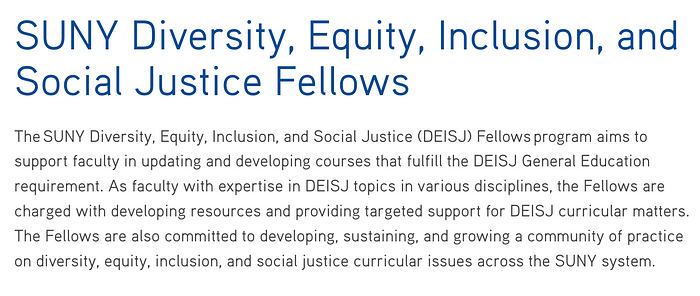
In summer 2023, prior to the fall launch of a new system-wide general education (GE) requirement in Diversity, Equity, Inclusion, and Social Justice, we were selected as “faculty with expertise in DEISJ topics” and charged with “developing resources and providing targeted support for DEISJ curricular matters.” The general education requirement includes student learning outcomes related to historical formations of social identity, systems of power that perpetuate inequality along lines of social identity, and (and this is the one we want to stress) applying DEI-related principles to social justice action: “apply the principles of rights, access, equity, and autonomous participation to past, current, or future social justice action.”
To support faculty in developing courses and course modules, we emphasized how the objectives are interconnected. The application of DEI principles in our critiques of how social systems and institutions perpetuate injustice for marginalized and minoritized communities, necessitate actions undertaken in service to actualizing social justice and liberation. According to SUNY’s Executive Vice Chancellor and Provost, Melur K Ramasubramanian, these three objectives are considered to be “fundamental aims of postsecondary undergraduate education.” Nevertheless, SUNY (and CUNY) administrators have and continue to act preemptively in compliance with the Governor of New York to suppress social justice actions in alignment with Palestinian liberation — shutting down efforts to name and analyze the ways governmental and higher educational institutions replicate dominant forms of power, privilege, and oppression.
In mid-October 2023, while building an online resource library for the new GE requirements, the SUNY DEISJ fellows received pushback when we suggested adding a folder with content that would aid faculty in teaching students about the settler state of Israel and the genocide in Gaza if it did not include “both sides.” Shortly thereafter, we were asked to facilitate a panel on “difficult conversations in the classroom” for the first “SUNY Diversity, Equity, Inclusion, and Social Justice in the Curriculum Conference” at SUNY Albany. When we expressed that it was urgent to discuss the political contexts around the genocide in Gaza, we were told that in our official capacity as SUNY fellows we should not address the conflict.
In May 2024, under the direction of Gov. Hochul, the Presidents of five SUNY colleges invited state police onto their campuses to violently disperse and demolish student encampments. Following the arrests of many SUNY students, faculty, and staff, the fellows wanted to develop and distribute a reading list for faculty to help them contextualize the protests within histories of student protest as social justice actions globally, including anti-apartheid demonstrations, Civil Rights demonstrations, and anti-war demonstrations. We were again directed not to distribute this as part of our formal work for SUNY.
How can faculty or administrators support learning focused on diversity, equity, inclusion, and social justice in the State of New York without addressing the state’s continued actions in restricting free speech, silencing academic communities, and stigmatizing teaching and learning about topics central to justice, freedom, and liberation on a global scale?
As WGSS scholars we are accustomed to being under attack for pointing out systemic oppression. Our interdisciplinary fields come directly out of social justice movements and represent the intersectional knowledge of those who understand social systems from a perspective of subordination. Faculty, staff, and students in our sibling area studies — Black Studies, Latinx Studies, Disability Studies — generate the exact skills and knowledge essential to resist current attacks on education. We are witnessing what “complying in advance” looks like in a blue state on the state education level, how the imagined differences between blue states and red states is just that — an imagined difference — that serves the interests of neoliberal and fascist governments alike.
The shock of Hochul’s actions signals to us that far too many folks continue to rely on our “blue state” and our democratic leadership to protect us and the stated values of our purported democracy. But — echoing a sentiment of the Black Lives Matter movement — we have to ask: who is the “us” that this “blue” protects? Any critique of Israel is being equated with antisemitism on college campuses through the weaponization of Title VI — this false equivocation comes from and is enforced by the right and the left, red and blue. We must be clear: as the United States descends into authoritarianism, it ultimately doesn’t matter what color state you’re in.
The federal administration is on a mission to demolish Gender, Sexuality, and Ethnic Studies at both the higher education and K-12 levels. The parallel between Hochul’s overreach of executive control to silence voices dedicated to Palestinian liberation and to remove people from potential leadership positions who do note align with state ideology and the Trump Administration’s stripping of government funding, removal of advisors with differing political positions, and executive orders that attack “DEI” as part of their anti-woke agenda must be acknowledged with eyes wide open. Our resistance efforts must include pushing our “democratic” leaders as they continue to fall in line with the Trump agenda.
Asked how he planned to respond to the administration’s February 14th “Dear Colleague” letter, SUNY Chancellor John B. King stated: “We’re going to continue to stand up for academic freedom and teaching the truth about our history. […] Slavery happened. The civil rights movement happened. […] It’s heartbreaking when you read about schools that are taking down their Harriet Tubman posters.” At the end of the interview, he adds,
“I think it is clear that the First Amendment protects the ability of individual faculty members and campuses to teach the truth about our history, to engage in conversations about issues of justice and equality. […] Our work with our campuses is both to make sure that we are continuing to advance SUNY’s values and also to ensure that we don’t engage in anticipatory over-compliance.”
In this framing, we protect Black history and Jewish people by talking about past injustice. To address the social justice part of the SUNY learning outcomes we must name what is happening now. We have to ask our leaders: why do these protections not apply to, for example, anti-Zionist Jews? To teach about state violence only after history has deemed it acceptable to name as violence is to capitulate to those violences.
If, as Chancellor King states, the vague and broad directives in the letter lead “to this chilling effect where people abandon core values of higher education because they’re responding to rhetoric rather than reality” then we demand that Chancellor King (and all those who claim a stake in DEISJ) act accordingly. He must unequivocally denounce Hochul’s action with the same fervor he denounced the actions of the current administration.
We call on invested faculty, staff, and community members to put pressure on both the SUNY and CUNY leadership to 1) support research and teaching in Palestinian and other decolonial knowledge areas; 2) uplift, fund, and protect Ethnic, Gender, Sexuality, and other area studies departments and programs that research and teach about social justice activism and decolonial theory and praxis; and 3) reject any directives that leverage a disingenuous and unfounded definition of “antisemitism” to silence social justice advocacy and organizing about Palestinian liberation and human rights abuses by the state of Israel, and 4) oppose any orders coming from state leadership that silence faculty, staff, and students with the same vigor as they have “opposed” demands to dismantle all DEI initiatives made by in the United States Department of Education’s “Dear Colleague” letter.
 Jessica N. Pabón, PhD
Leave a comment